![fidesic-logo-300px-2023-2.png]](https://help.fidesic.com/hs-fs/hubfs/fidesic-logo-300px-2023-2.png?height=40&name=fidesic-logo-300px-2023-2.png)
“You Don’t have security privileges to open this window. Contact your System administrator for assistance.”
GP shows this message when the user's security roles don't include the Fidesic window they are opening. Give the user a security role that includes Fidesic.
Fix it with the Fidesic security script
The FIDESIC_Security_Task_And_Role.sql script at the end of this article sets up Fidesic security in one step:
- A security task, FIDESIC, with every Fidesic window, report and table.
- A security role, FIDESIC, that contains the task.
The script is made for the Fidesic AP module for GP 2018 and later, version 18.6.5. For the Fidesic AR module or an older version, set up security by hand instead.
Run the script
- Open SQL Server Management Studio and connect to your GP SQL Server with a login that can change the system database, such as
sa. - Open a new query window on your GP system database, normally DYNAMICS. Don't use a company database.
- Copy the whole script into the window and run it.
- Check the Messages tab. A first run shows Created security task FIDESIC, Added 51 Fidesic windows, reports and tables to the task, Created security role FIDESIC and Added 2 task(s) to the role.
The script is safe to run more than once. It only adds what is missing, and never changes or removes existing security. If you already have a security task with the ID FIDESIC, it adds any Fidesic windows, reports and tables that task is missing.
Give users the role
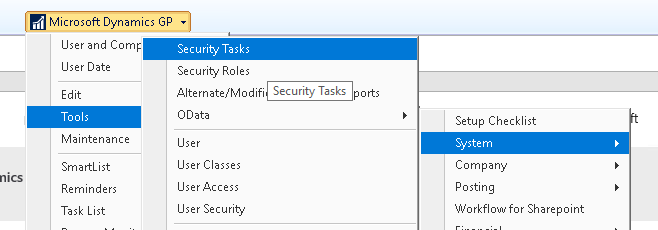
- Microsoft Dynamics GP menu > Tools > Setup > System > User Security
- Select the user and the company.
- Check FIDESIC in the roles list and click Save.
- Repeat for each company where the user works with Fidesic.
Set up security by hand
Use these steps instead of the script for the Fidesic AR module or an older AP version. This gives users permission to open Fidesic's windows and use its tables and reports in GP. Afterwards, give the role to every user who needs Fidesic.
- Microsoft Dynamics GP menu > Tools > Setup > System > Security Tasks
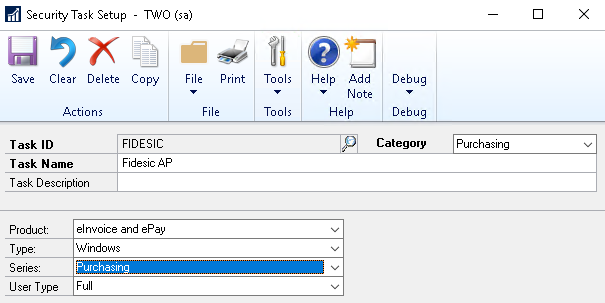
- Create a Task ID - call it "Fidesic Tasks" or similar nomenclature.
- Category: Sales or Purchasing (depending on AR or AP install of our solution)
- Task Name: (your choice), Task Description: (your choice)
- Product: eInvoice and ePay
- Type: Windows, Reports, Files (you need to select each one of these, then proceed to step 7 below for each)
- Series: Sales, Purchasing, System, Company, 3rd Party
- Enable all operations in the Access List to allow access to the actions.
- Save
- Microsoft Dynamics GP menu > Tools > Setup > System > Security Roles
- Select the Role ID for the user you wish to grant Fidesic access to in GP
- Select "Fidesic Tasks" (or whatever you named the Task in step 2)
- Click Save.
If the error is on a window you don't use
If this error is occuring on a window you do not plan to use, you can disable either AR or AP triggers in GP to prevent the fidesic module from attempting any operation.
- MS Dynamics GP Menu -> Tools -> Setup -> Company ->Fidesic Company Options
- Then you'll need to check the box next to "Disable Receivables Triggers" or "Disable Payables Triggers" depending on which product you'd like to disable.
FIDESIC_Security_Task_And_Role.sql
Copy the whole script into a new query window in SQL Server Management Studio, on your GP system database (normally DYNAMICS).
/*
*    Fidesic security task and role for Microsoft Dynamics GP
*
*    Creates, in one step, what Security Task Setup and Security Role Setup create by hand:
*      - Security task FIDESIC (category Purchasing) with every Fidesic window, report and table
*        (product eInvoice and ePay, dictionary 2703).
*      - Security role FIDESIC containing the FIDESIC task and GP's DEFAULTUSER task.
*    It does not assign the role to any user. Do that in Security > User Security as usual.
*
*    Run it against the GP SYSTEM database (normally DYNAMICS), not a company database.
*    Run it once per GP install: tasks and roles are shared by every company.
*
*    Safe to run more than once. It only adds what is missing and never changes or removes
*    an existing task, role or assignment. Re-run it after a Fidesic update that adds windows,
*    reports or tables, using the version of this script that ships with that update.
*
*    Script version 2026-11-17. Made for the Fidesic AP module for GP 2018 and later, version 18.6.5.
*/

SET NOCOUNT ON;
SET XACT_ABORT ON;

DECLARE @TaskID    char(25) = 'FIDESIC';
DECLARE @TaskName  char(51) = 'Fidesic';
DECLARE @TaskDesc  char(255) = 'Fidesic windows, reports and tables';
DECLARE @TaskCategory smallint = 3;     -- Purchasing

DECLARE @RoleID    char(25) = 'FIDESIC';
DECLARE @RoleName  char(51) = 'Fidesic';
DECLARE @RoleDesc  char(255) = 'Access to Fidesic in Dynamics GP';

DECLARE @FidesicDictID smallint = 2703;
DECLARE @UserID    char(15) = 'sa';
DECLARE @Today     datetime = CONVERT(date, GETDATE());

IF OBJECT_ID('dbo.SY09000') IS NULL OR OBJECT_ID('dbo.SY10700') IS NULL
   OR OBJECT_ID('dbo.SY09100') IS NULL OR OBJECT_ID('dbo.SY10600') IS NULL
BEGIN
    RAISERROR('This is not the GP system database. Switch to DYNAMICS (or your system database) and run again.', 16, 1);
    RETURN;
END

DECLARE @Resources TABLE (SECRESTYPE smallint NOT NULL, SECURITYID int NOT NULL);
INSERT INTO @Resources (SECRESTYPE, SECURITYID) VALUES
    -- Files (tables)
    (1, 22001), (1, 22002), (1, 22004), (1, 22007), (1, 22009), (1, 22011), (1, 22012),
    (1, 22013), (1, 22014), (1, 22016), (1, 22017), (1, 22018), (1, 22019), (1, 22020),
    (1, 22021), (1, 22022), (1, 22023), (1, 22024), (1, 22025), (1, 22028), (1, 22029),
    -- Windows
    (2, 22000), (2, 22001), (2, 22002), (2, 22004), (2, 22005), (2, 22006), (2, 22007),
    (2, 22008), (2, 22009), (2, 22010), (2, 22011), (2, 22012), (2, 22013), (2, 22014),
    (2, 22015), (2, 22016), (2, 22017), (2, 22018), (2, 22019), (2, 22020), (2, 22021),
    (2, 22022), (2, 22023),
    -- Reports
    (23, 22000), (23, 22001), (23, 22002), (23, 22003), (23, 22004), (23, 22005), (23, 22006);

DECLARE @Added int;

BEGIN TRANSACTION;

/****** SECURITY TASK ******/
IF NOT EXISTS (SELECT 1 FROM dbo.SY09000 WHERE SECURITYTASKID = @TaskID)
BEGIN
    INSERT INTO dbo.SY09000
        (SECURITYTASKID, SECURITYTASKNAME, SECURITYTASKDESC, SECURITYTASKCATEGORY, DEFSECTASK,
         CRUSRID, CREATDDT, MDFUSRID, MODIFDT, Workflow_Status,
         SecurityTaskNameModified, SecurityTaskDescModified, SecurityTaskCatgModified, WorkflowOriginCompany)
    VALUES
        (@TaskID, @TaskName, @TaskDesc, @TaskCategory, 0,
         @UserID, @Today, '', '19000101', 9,
         '', '', 0, '');
    PRINT 'Created security task ' + RTRIM(@TaskID);
END
ELSE
    PRINT 'Security task ' + RTRIM(@TaskID) + ' already exists';

INSERT INTO dbo.SY10700 (SECURITYTASKID, DICTID, SECURITYID, SECRESTYPE)
SELECT @TaskID, @FidesicDictID, r.SECURITYID, r.SECRESTYPE
FROM @Resources r
WHERE NOT EXISTS (SELECT 1 FROM dbo.SY10700 t
                  WHERE t.SECURITYTASKID = @TaskID
                    AND t.DICTID = @FidesicDictID
                    AND t.SECURITYID = r.SECURITYID
                    AND t.SECRESTYPE = r.SECRESTYPE);
SET @Added = @@ROWCOUNT;
PRINT 'Added ' + CAST(@Added AS varchar(10)) + ' Fidesic windows, reports and tables to the task';

/****** SECURITY ROLE ******/
IF NOT EXISTS (SELECT 1 FROM dbo.SY09100 WHERE SECURITYROLEID = @RoleID)
BEGIN
    INSERT INTO dbo.SY09100
        (SECURITYROLEID, SECURITYROLENAME, SECURITYROLEDESC, SECROLETYPE,
         CRUSRID, CREATDDT, MDFUSRID, MODIFDT, Workflow_Status,
         SecurityRoleNameModified, SecurityRoleDescModified, WorkflowOriginCompany)
    VALUES
        (@RoleID, @RoleName, @RoleDesc, 2,
         @UserID, @Today, '', '19000101', 9,
         '', '', '');
    PRINT 'Created security role ' + RTRIM(@RoleID);
END
ELSE
    PRINT 'Security role ' + RTRIM(@RoleID) + ' already exists';

/****** TASKS IN THE ROLE ******/
INSERT INTO dbo.SY10600 (SECURITYROLEID, SECURITYTASKID)
SELECT @RoleID, x.SECURITYTASKID
FROM (VALUES (@TaskID), (CAST('DEFAULTUSER' AS char(25)))) x (SECURITYTASKID)
WHERE EXISTS (SELECT 1 FROM dbo.SY09000 t WHERE t.SECURITYTASKID = x.SECURITYTASKID)
  AND NOT EXISTS (SELECT 1 FROM dbo.SY10600 rt
                  WHERE rt.SECURITYROLEID = @RoleID AND rt.SECURITYTASKID = x.SECURITYTASKID);
SET @Added = @@ROWCOUNT;
PRINT 'Added ' + CAST(@Added AS varchar(10)) + ' task(s) to the role';

COMMIT TRANSACTION;

PRINT 'Done. Assign the ' + RTRIM(@RoleID) + ' role to users in Microsoft Dynamics GP > Tools > Setup > System > User Security.';